
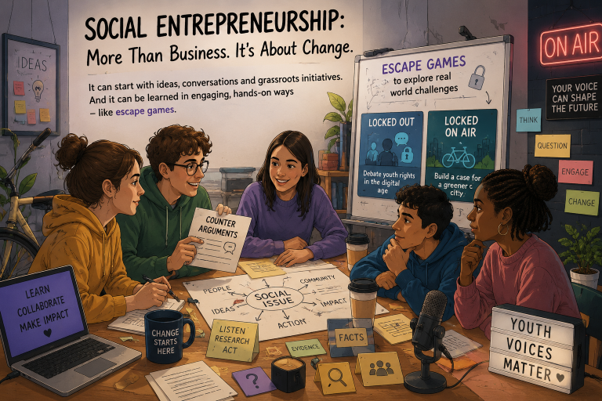
When people hear the term “social entrepreneurship”, they often immediately think about businesses generating profit to support social causes. While this is one important dimension, social entrepreneurship can take many other forms. At its core, it is about identifying social challenges, mobilising communities and creating innovative grassroots solutions that generate positive social impact.
Social entrepreneurship does not always begin with funding, companies or commercial models. Sometimes it starts with people discussing a local issue, organising a campaign, raising awareness or engaging citizens in democratic participation. In this sense, civic engagement itself can become a form of social entrepreneurship when it empowers communities and contributes to social change.
This broader understanding is at the heart of the DEGSE project, which explores how digital escape games can help young people develop entrepreneurial, civic and critical-thinking competences in engaging and interactive ways. Among the new games currently being developed are two scenario-based escape experiences focused on contemporary public debates.
Under 15 – Access Denied!
In this game young founders of a start-up heavily relying on social media promotion have to respond to a controversial government proposal that could restrict social media access for young people under the age of 15. Locked inside a meeting room before a national consultation hearing, players must analyse government arguments, identify weaknesses in the official White Paper and build convincing counterarguments balancing youth protection with digital rights and participation.
Can you make it fairly?
The game takes place in a small hobbyist podcasting studio run by young cyclists. As their city prepares for a referendum on banning combustion engine cars from the city centre, public opinion becomes increasingly polarised and most citizens oppose the proposal. Concerned about pollution and the future of sustainable urban mobility, the team decides to engage in the debate by preparing a podcast defending the vision of a greener, cyclist-friendly city. Participants play the role of the team locked inside the studio until they manage to create a convincing podcast storyboard addressing the main arguments circulating against the ban.
Both the games introduce young people to the concept of social entrepreneurship that engages in public debate, participation and collective problem-solving. By using escape room mechanics, players are encouraged not only to cooperate and think critically, but also to engage with complex real-world social issues affecting their communities.
Through initiatives like these, the DEGSE project aims to show that learning about civic engagement, sustainability and democratic participation can be both meaningful and highly interactive.
Keep an eye on the DEGSE Resources page, where 10 new escape games along with other useful educational resources will be shared soon, including the ones mentioned above.
Picture created with AI support (ChatGPT)