
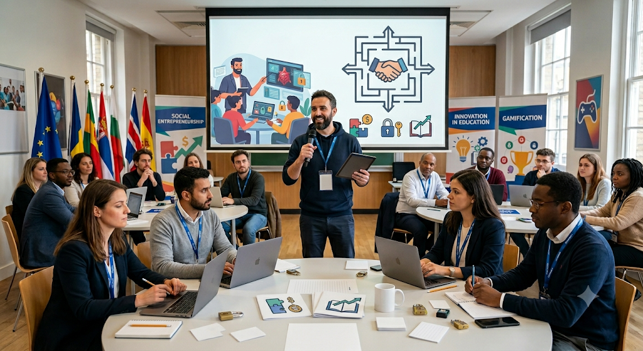
When people think about escape rooms, they usually picture locked doors, hidden clues, and teams racing against the clock. When they think about policymakers, they imagine regulations, strategies, and public consultations. At first glance, these worlds seem far apart.
But look closer, and an interesting comparison emerges: both game masters and policymakers are designers of experiences. Neither directly solves the challenges faced by participants. Instead, they create the conditions that enable people to succeed.
In many ways, the future of effective policymaking may have more in common with a well-designed escape room than we think.
A good game master does not create rules to make players fail. The goal is to create a fair challenge that is engaging, motivating, and achievable. Participants should feel stretched, not excluded.
The same principle applies to public policy. Whether designing youth programmes, educational reforms, or entrepreneurship initiatives, policymakers must create frameworks that encourage participation while removing unnecessary barriers. Research from the OECD highlights that effective learning environments are those that are engaging, welcoming, and responsive to the needs of diverse learners. Policies work best when they help people navigate challenges rather than simply imposing restrictions.
The question for policymakers is simple: Are citizens struggling because the challenge is meaningful, or because the rules themselves create obstacles?
Experienced game masters know that no two teams are alike. Some players are analytical, others creative. Some need additional hints, while others prefer greater autonomy. The best escape rooms are designed to accommodate different problem-solving styles and abilities.
Modern policymaking faces a similar challenge. Diversity is no longer an exception – it is the norm. OECD research emphasizes that equitable systems require learning environments and policies that respond to the needs of diverse populations and actively involve stakeholders throughout the policy cycle.
This idea is particularly relevant for youth work and education. If programmes only work for the most advantaged participants, they are not truly successful. Inclusion should not be an afterthought; it should be part of the design from the beginning.
The Digital Escape Rooms for Social Entrepreneurship (DEGSE) project embraces this principle by developing resources that are accessible, multilingual, and designed with inclusion in mind, including consideration for young people with specific learning needs.
One of the key responsibilities of a game master is deciding when and how to provide hints. Too much guidance makes the experience boring. Too little creates frustration.
Effective public policy requires the same balance. Citizens, educators, and young people need clear feedback mechanisms that help them understand how to improve and participate. Policies that rely solely on compliance and penalties often fail to inspire engagement.
Interestingly, studies on game-based learning show that well-designed games increase motivation, engagement, and knowledge acquisition because participants receive continuous feedback and can learn through experimentation.
What if more public initiatives were designed as learning journeys rather than administrative procedures?
Most escape rooms cannot be completed alone. Success depends on communication, trust, and the ability to combine different perspectives.
Societies face increasingly complex challenges – from climate change and social inclusion to youth unemployment. No single institution can solve these issues independently. Policymakers, educators, NGOs, businesses, and citizens must collaborate.
Research on collaborative escape room experiences has even shown their potential to strengthen understanding and cooperation between different groups.
Perhaps the most important lesson from game masters is that meaningful progress happens when people feel they are part of the solution.
Traditionally, policymakers have been viewed as rule-makers. But the challenges of the 21st century require a different mindset: the policymaker as a designer of environments where people can learn, contribute, and thrive.
Game masters understand that success is not measured by how difficult the game is. It is measured by what participants experience, learn, and remember.
The same could be said for public policy.
As digital tools, gamification, and innovative educational methods become more common, policymakers have an opportunity to rethink how citizens engage with public initiatives. Projects such as DEGSE demonstrate that interactive approaches – like digital escape rooms for social entrepreneurship – can foster creativity, teamwork, critical thinking, and active citizenship in ways that traditional methods often struggle to achieve.
In the end, both game masters and policymakers share the same mission: creating fair, inclusive, and inspiring environments where people can unlock their potential.
The only difference is that one designs puzzles, while the other helps society solve them.
References