People collaborate in different ways: some jump in immediately, ready to lead and think out loud, while others need a moment to quietly observe and process before they contribute their best idea. Good collaborative learning design makes room for various methods and behaviours, and digital escape games, when built well, precisely rely on this principle. Rather than simply encouraging collaboration, they make teamwork structurally unavoidable.
Online collaboration has a well-documented problem: without careful design, it tends to collapse into parallel individual effort. Tasks get divided, people work on separate paths and the group reassembles at the end to stitch the pieces together. That is coordination, not collaboration. Add to this the specific fatigue that video calls produce, and the conditions for genuine collective thinking become even harder to create.
Digital escape games sidestep this dynamic entirely: when there is a shared puzzle to solve, participants stop watching themselves and each other; they focus on the same goal and start working together.
What makes this format genuinely powerful goes beyond motivation. Research on educational escape games consistently describes participants not as passive recipients of information, but as active constructors of their own knowledge, engaged in real decision-making within a dynamic environment. This is a crucial distinction, and it is precisely what makes the format so well-suited to social entrepreneurship education. Social enterprises are built through negotiation and collective decision-making under conditions of uncertainty, with the patient integration of diverse skills and perspectives. These capacities need to be practised in conditions that feel real enough to demand something, but safe enough to allow mistakes.
The resources of the DEGSE project, specifically our upcoming digital escape games, are designed with exactly this in mind: scenarios grounded in real social challenges, where progress depends on the group’s ability to think, communicate and apply solutions together.
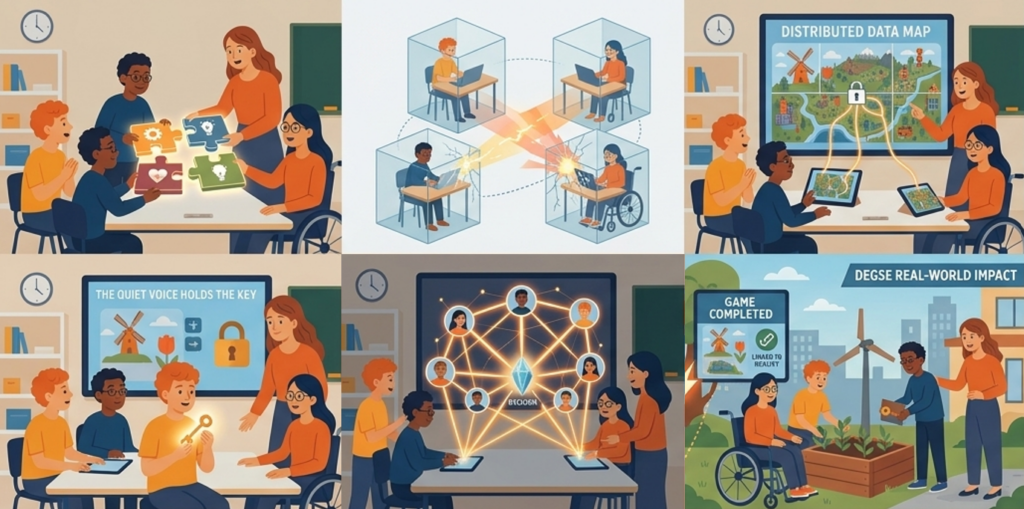
The most effective digital escape games distribute information across players so that no individual can move forward without sharing what they know. They include moments where the group must align before advancing, where the quieter voice in the room might hold the key piece of the puzzle.
Time pressure plays a role here too: the countdown timer compels learners to make decisions together quickly, mirroring the real conditions of community-based work where resources are finite and communities are waiting. Collaboration, in this sense, is not something players bring to the escape game. It is something the escape game draws out of them.
Equally important is what happens after the game ends: the debrief, in the form of a structured conversation that follows a game session, is where experience becomes understanding. A skilled facilitator helps teams bring what actually happened to the surface: who took initiative, whose ideas shaped the group’s direction, where communication broke down, and what they would do differently. This reflection is not a bonus activity; it is the moment when play transforms into transferable insight, and when young people begin to recognise their own collaborative patterns and imagine how to strengthen them.
Youth workers using DEGSE’s resources, such as our guides, ready-to-use escape games, tools, tutorials and recommended practices, can more effectively implement such methods. Through those outputs, they can receive adequate support to explore and apply escape game design recommendations, facilitation techniques, briefing and debriefing requirements and key soft skills, to adequately facilitate this kind of activity, connecting a curated, educational game experience to the broader competencies of social entrepreneurship and active citizenship.
Collaborative online or digital learning is not something that happens by default. It has to be deliberately designed with the learner’s experience at the centre. When the game requires every voice and mindset, no one can succeed without the others’ contribution and the debrief is treated as seriously as the game itself, something shifts. Young people stop being simple participants in a learning activity and start becoming members of a team that is, slowly and playfully, learning how to change things together.
Every team has that moment when the solution suddenly becomes clear, not because someone solved it, but because everyone did so by putting the pieces together. Good design and adapted resources, such as the DEGSE project results, ensure that young people are given the opportunities and tools they need to experience collaboration in a safe and controlled environment, and learn to make their social entrepreneurship goals a reality.
References