
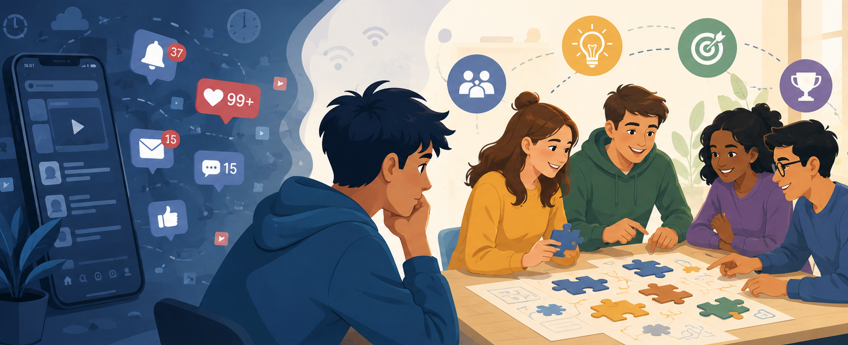
“Your attention is the most valuable resource you own – and everyone wants a piece of it.”
From the moment we wake up, our attention is constantly being pulled in different directions. Notifications, social media feeds, short videos, advertisements, emails, and instant messages compete for a few seconds of our focus. In what many experts now call the attention economy, digital platforms are specifically designed to capture and retain users’ engagement for as long as possible.
For educators and youth workers, this creates an important question: how can meaningful learning compete in a world where distraction has become the default?
The answer may not be to make education look more like social media. Instead, it may be about designing learning experiences that deserve learners’ attention.
It is easy to assume that young people today simply have shorter attention spans. However, research suggests a more nuanced reality. Young people can spend hours focused on activities they find meaningful, whether playing a cooperative video game, creating digital content, solving complex challenges, or participating in online communities.
The real issue is not that attention has disappeared – it is that it has become highly selective.
Digital platforms invest enormous resources into understanding human behaviour. Every recommendation, notification, and interface element is carefully designed to encourage users to stay engaged. Educational environments, on the other hand, often continue to rely on methods developed long before the digital age.
This does not mean education should imitate social media. Rather, it highlights the importance of designing learning experiences that are interactive, purposeful, and capable of maintaining learners’ intrinsic motivation.
According to UNESCO (2025), game-based learning represents one promising approach because it encourages active participation, sustained engagement, and collaborative problem-solving rather than passive information consumption.
One of the greatest differences between scrolling through social media and participating in a well-designed educational activity lies in the learner’s role.
Scrolling is largely passive. Information arrives continuously, requiring little decision-making or reflection. The user consumes content without necessarily interacting with it in meaningful ways.
Educational games – and particularly escape rooms – work differently.
Instead of simply receiving information, participants are required to analyse clues, make decisions, test hypotheses, communicate with teammates, and solve interconnected problems. Every action influences the next step of the experience.
This active involvement is closely connected to the concept of flow, introduced by psychologist Mihaly Csikszentmihalyi. Flow describes a mental state in which people become fully immersed in an activity because the challenge perfectly matches their skills. During flow, distractions fade into the background, motivation increases, and learning often becomes more effective.
Rather than fighting for attention through louder stimuli or faster content, educational games create conditions where attention naturally emerges from meaningful participation.
The challenge facing education today is not simply competing with smartphones or social media. In reality, it is about rethinking how learning experiences are designed.
Young people are not unwilling to learn. Every day, they demonstrate remarkable persistence when they engage in activities that are meaningful, challenging, and rewarding. The popularity of collaborative games, online communities, and creative digital platforms shows that motivation thrives when learners feel involved and empowered.
Educational experiences should aspire to create that same sense of purpose.
This does not mean transforming every lesson into a game or replacing traditional teaching methods with digital technologies. Instead, it means recognising that learning is most effective when learners actively participate, make decisions, collaborate with others, and feel ownership of the process.
Game-based learning offers valuable insights because it focuses on experience rather than information alone. Well-designed educational games create safe spaces where participants can experiment, fail, reflect, and try again – developing not only knowledge but also confidence, resilience, and teamwork.
These qualities are becoming increasingly important in a world where information is abundant but critical thinking, collaboration, and problem-solving are what truly make the difference.
The Digital Escape Games for Social Entrepreneurship (DEGSE) project embraces this educational perspective by exploring how digital escape rooms can become powerful learning environments for young people.
Rather than using games simply to make learning more entertaining, DEGSE promotes experiences that encourage participants to engage with real-world social challenges through collaboration, creativity, and critical thinking. By combining game mechanics with social entrepreneurship education, the project supports youth workers in designing activities that are both motivating and meaningful.
In doing so, DEGSE reflects a broader shift taking place across education: moving away from passive knowledge transmission towards active, learner-centred experiences that prepare young people for an increasingly complex world.
In an age where countless platforms compete for our attention, education should not try to win by becoming louder or faster. Instead, it can succeed by offering something fundamentally different: experiences that invite learners to think deeply, collaborate meaningfully, and solve problems that matter.
Attention is indeed a valuable currency – but perhaps the ultimate goal of education is not simply to capture it. It is to inspire learners to invest it willingly in experiences that foster curiosity, growth, and positive social impact.
Projects such as DEGSE demonstrate that educational innovation is not about competing with social media on its own terms. It is about creating learning experiences that people genuinely want to be part of – experiences that transform attention into participation, participation into learning, and learning into action.
References