
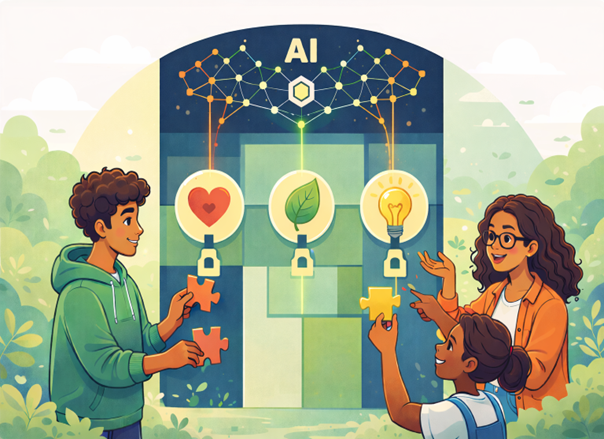
Playing smarter: how AI is reshaping youth social entrepreneurship
Artificial intelligence is no longer a distant or abstract concept. For young people engaged in social entrepreneurship, AI is increasingly becoming a practical tool that supports creativity and problem-solving. When combined with game-based learning approaches, such as escape rooms and serious games, AI opens new pathways for experiential learning and youth-led innovation.
At the same time, the use of AI raises important ethical and practical concerns that cannot be overlooked. AI systems can reproduce biases present in their training data or provide inconsistent or opaque outputs. Without critical understanding, young people may over-rely on AI suggestions and overlook social and contextual factors.
For this reason, it is essential to integrate AI literacy into youth learning processes. Game-based learning offers a safe environment to explore not only the benefits of AI, but also its limitations, risks and responsibilities. Teaching young people how to question AI outputs, recognise bias, validate information and make informed decisions is a necessary step to ensure that AI becomes a supportive tool for social entrepreneurship.
AI as a co-creator, not a shortcut
For young social entrepreneurs, AI is most valuable when used as a supportive partner rather than a replacement for human creativity. Tools powered by AI can help learners brainstorm solutions, analyse community challenges or simulate the potential impact of an idea. For example, youth teams can use AI to explore different business models for a social initiative, test assumptions or refine their value proposition before engaging real stakeholders.
In learning environments, this mirrors entrepreneurial reality: decisions are informed by data and tools, but responsibility and judgement remain human.
Escape rooms as AI-enhanced learning spaces
Escape rooms and educational games provide a natural entry point for exploring AI-driven entrepreneurship. In a social entrepreneurship escape room, learners might face challenges such as allocating limited resources, responding to community needs or balancing financial and social objectives. AI can be integrated into these scenarios as a “digital advisor,” offering needed information or valuable feedback.
This approach helps young people experience how AI can support decision-making under pressure, without presenting it as an all-knowing authority.
Designing with impact in mind
AI also plays a role in design thinking and prototyping. In game-based settings, AI tools can be used to generate alternative solutions, adapt scenarios for different target groups or personalise game content to reflect real social contexts. This is particularly relevant for inclusive entrepreneurship, where solutions must respond to diverse needs and lived experiences.
With AI embedded into playful, scenario-based activities, learners develop critical awareness of both the opportunities and limitations of technology.
From play to real-world practice
What makes the combination of AI and games powerful is the transition from simulation to action. Escape rooms and serious games allow young people to experiment safely and reflect collectively. These experiences build confidence and competence that can later be transferred to real social entrepreneurship projects, such as designing a community initiative or launching a social enterprise. AI, in this context, becomes a learning catalyst rather than an end goal.
Preparing young people for an AI-shaped future
However, young people need more than technical skills in the use of AI. They need ethical awareness and critical ability to see not only possibilities but also threats. Game-based learning methods such as escape rooms provide structured yet flexible environments where these competences can be developed in meaningful ways.
This approach is fully in line with DEGSE that helps ensure that young social entrepreneurs are responsible social innovators. DEGSE Youth Workers Guide in particular will be a good opportunity to explore the benefits and risks of AI as well and its applications to social entrepreneurship.
(Picture created with AI support (DALL-E)