
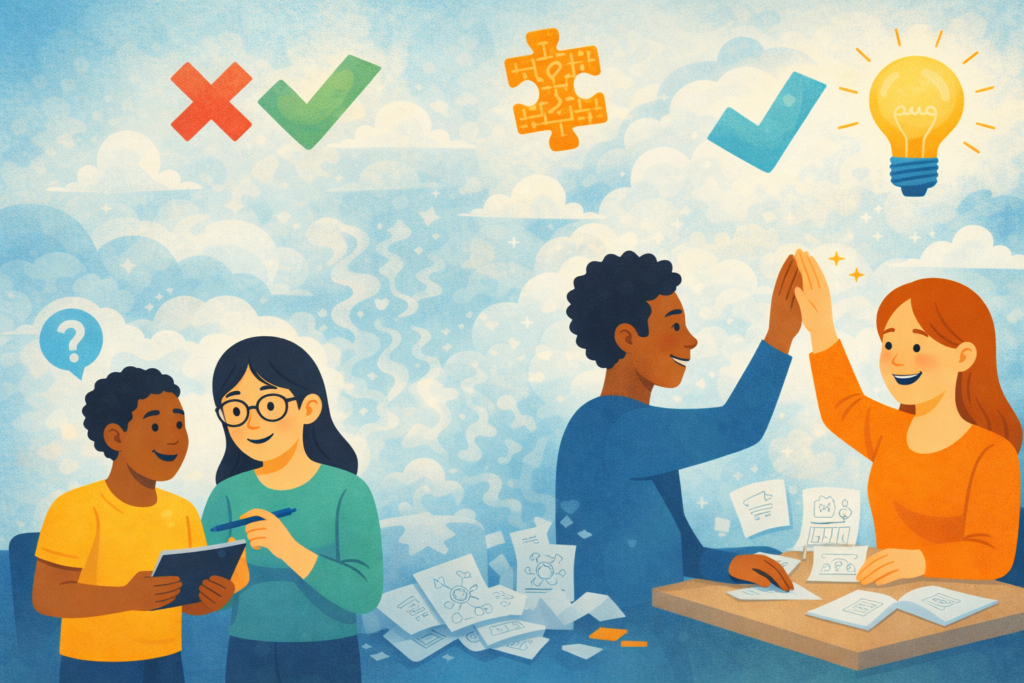
In traditional education systems, failure is often penalised. Mistakes lower grades. Wrong answers carry consequences. Risk-taking is discouraged in favour of certainty. Yet in the real world, especially in social entrepreneurship, failure is not a weakness. It is a process.
If we are preparing young people to address complex social challenges, we must rethink how they experience risk, uncertainty, and experimentation. And this is where playful, gamified learning environments become transformative.
Social entrepreneurs operate in unpredictable contexts.
They test ideas, receive feedback, adapt, and try again. Rarely does the first solution succeed exactly as planned. Learning environments that discourage failure create future leaders who fear experimentation. By contrast, digital escape rooms and game-based simulations create low-stakes environments for high-stakes thinking.
Learners can:
All without real-world harm. This builds resilience, a core entrepreneurial competence.
Research in education and organisational psychology consistently highlights the importance of psychological safety: the feeling that one can speak up, take risks, and make mistakes without embarrassment or punishment.
In well-designed digital escape rooms, failure is part of the narrative. A wrong code doesn’t end the experience, it invites reflection.
This subtle shift reframes mistakes from endpoints to stepping stones.
For young people exploring social entrepreneurship, this mindset is powerful. It transforms fear into curiosity.
Many young learners hesitate to share ideas because they want them to be “perfect.” But innovation rarely emerges fully formed.
Gamified environments encourage iteration:
In social entrepreneurship training, this mirrors real venture development cycles — prototyping, feedback, pivoting.
By practising iterative thinking in simulated contexts, learners internalise a growth-oriented approach that carries into real-world projects.
Digital escape rooms are not just engaging tools, they function as micro-laboratories for decision-making. Participants face time pressure, incomplete information, and collaborative challenges. They must negotiate, test hypotheses, and adapt quickly.
Importantly, they can also debrief afterward reflecting on: What worked? What failed? Why? What would we do differently?
This reflection phase transforms play into structured learning.
If education only rewards correct answers, it limits creative courage. If education rewards exploration, reflection, and adaptation, it cultivates changemakers.
As learning becomes more immersive and technology-supported (as explored in our previous article on the future of playful learning), the opportunity is not just to make education more engaging, but to make it more aligned with real innovation processes.
The future of social entrepreneurship education must normalise experimentation, because the challenges young people will face such as climate transitions, social inequalities, digital ethics, have no single “correct” answer.
They require exploration.
Projects like DEGSE Digital Escape Rooms for Social Entrepreneurship demonstrate how structured play can create environments where young people learn to think boldly, adapt quickly, and reflect deeply.
Failure, in this context, is not something to avoid. It is something to learn from.
If we want empowered young changemakers by 2030, we must give them something traditional education rarely provides: the freedom to try and the safety to fail.