
The future of learning is playful: Predictions for 2030
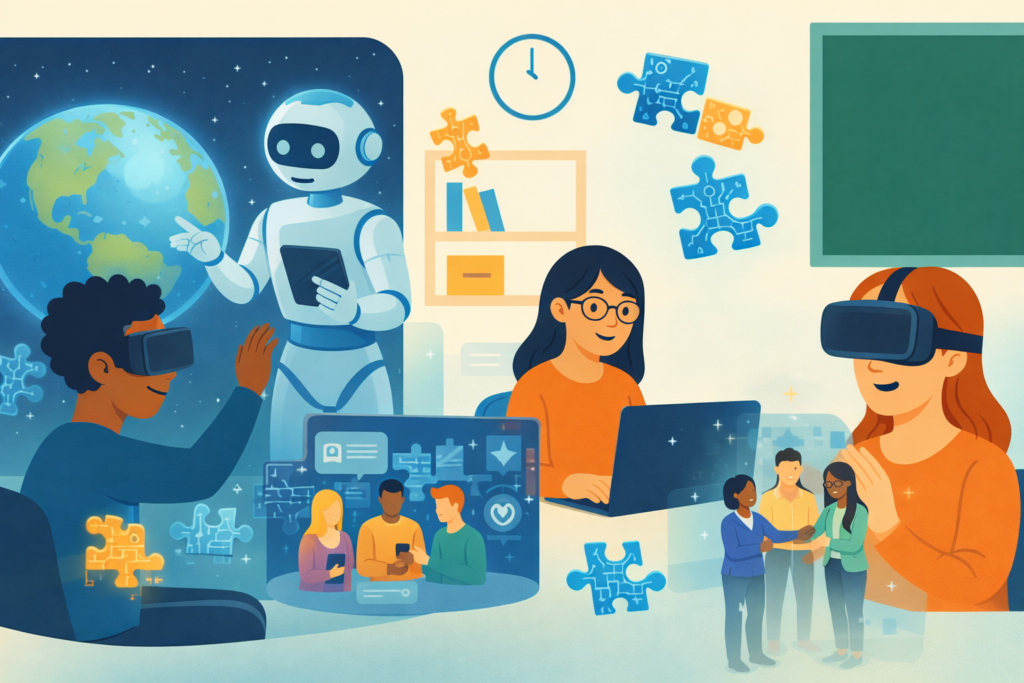
Imagine stepping into a classroom without desks. Instead, you put on a lightweight headset and suddenly you’re standing inside an ancient civilisation, exploring its streets and marketplaces. In another room, a group of young social innovators collaborate with a generative AI mentor to design inclusive enterprises in a virtual city. This may sound like science fiction, but by 2030, playful learning through digital games, virtual reality (VR), and artificial intelligence (AI) could become the norm, transforming how we educate and empower youth.
1. Learning that feels like play
By 2030, the global EdTech landscape is expected to expand dramatically – with immersive technologies at its core. Analysts forecast that educational technology revenues could more than double by the end of the decade as schools, universities, and community groups adopt VR/AR platforms and gamified learning environments. Traditional textbooks may give way to interactive, simulation-based learning that feels more like gaming than rote instruction. This shift to immersive worlds – sometimes described as the Metaverse of education – combines big data, AI, and interactive design to create personalised learning paths for each student.
In these environments, students don’t just memorise facts – they experience them. Whether rescuing an endangered ecosystem in a virtual jungle or solving financial puzzles in a bustling digital economy, learners are actively engaged and intrinsically motivated.
2. AI as tutor, assistant, and learning companion
AI is already being used to tailor traditional curricula and provide personalised feedback to students. By 2030, advances in generative AI will allow systems to act as dynamic tutors that adjust lessons in real time based on individual performance, learning style, and emotional engagement. Researchers are already exploring the use of AI in VR environments, such as personalised narration and engagement tracking to optimize learning outcomes.
In play-based scenarios, AI may also co-design missions with learners or act as a guide through complex simulations. For social entrepreneurship training, this means aspiring change-makers could “practice” launching and scaling ventures in safe virtual spaces, iterating through business choices with AI feedback before stepping into real communities.
3. Empathy and social skills through immersive tech
It’s not all logic and strategy – one of the surprising advantages of VR and AI learning environments is their potential to nurture empathy and emotional intelligence. Recent projects are using AI-powered VR experiences to help learners understand others’ perspectives, manage emotions, and navigate complex social scenarios. These are essential skills for future leaders, especially in fields like social entrepreneurship that depend on understanding community needs and building trust.
In such virtual experiences, classmates may take on roles in a simulated community, cooperating to solve societal challenges. These shared narratives make learning deeply relational – turning empathy into an acquired skill, not just an abstract concept.
4. Beyond classrooms: networks of innovation
As playful technologies grow, learning won’t be confined to formal institutions. Community centres, libraries, and youth organisations are increasingly becoming hubs of gamified learning. These spaces can provide access to tech, mentorship, and hybrid experiences that blend real-world problem-solving with digital exploration. This opens up education beyond age, background, or geography, helping young people everywhere unlock their creative potential.
The DEGSE project – developing digital escape rooms for social entrepreneurship – is a perfect example of this trend: mission-based play that builds entrepreneurial mindsets, teamwork, and practical problem-solving skills, all through interactive, engaging formats.
5. The road ahead: challenges and opportunities
Of course, a playful future of learning comes with questions:
- How do we ensure equitable access to immersive technologies?
- How can educators blend human mentorship with AI guidance without losing the human touch?
- What ethical frameworks are needed to protect learner data and well-being?
Addressing these concerns will require collaboration among policymakers, educators, technologists, and young people themselves.
But if the trends hold true, by 2030, play will no longer be a distraction from learning – it will be its heartbeat. Through gamified experiences, virtual exploration, and AI-assisted discovery, the next generation won’t just consume knowledge – they will co-create it, unlocking new approaches to education and social innovation that are as playful as they are profound.
References
- Picture created with ChatGPT
- Education 5.0: Requirements, Enabling Technologies, and Future Directions. ArXiv (2023).
- Metaverse in Education: Vision, Opportunities, and Challenges. ArXiv (2022).
- How educational technologies may look by 2030 — including VR and AI. offnews.bg.
- Personalized Generative AI in VR for Enhanced Engagement. ArXiv (2024).
- VR and AI can help children develop empathy. bg.
- Libraries and digital skills training hubs as learning spaces. Reddit r/bulgaria.